
The Heart
Your heart plays and important part in being healthy. It keeps all the blood in your circulatory system flowing. Blood helps oxygen get around your body. When you exercise you can feel your pulse, it tells you how fast your heart is pumping.
Avoiding cigarettes and alcohol, eating right and exercising help your health and fitness.


Breif Information
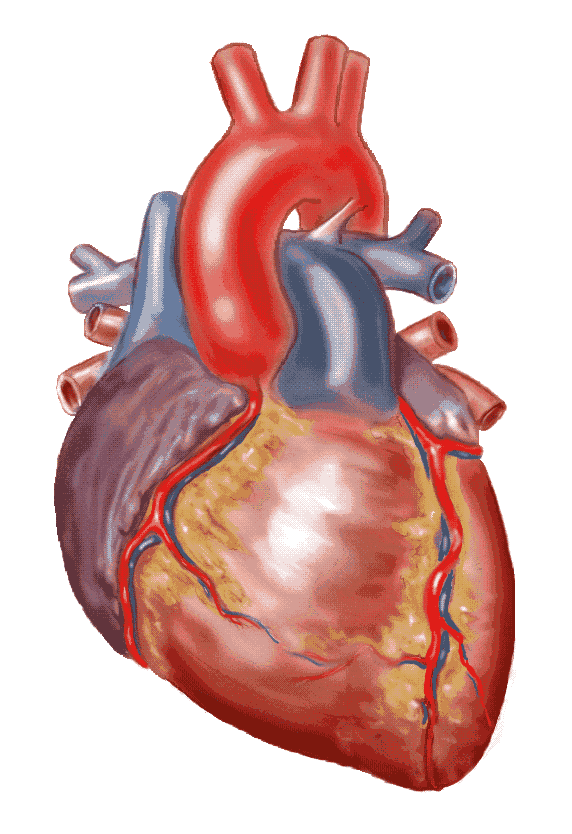
Your heart is a very strong muscle that pumps blood around your body.
It is made of four chambers, two upper chambers and two lower chambers. Blood enters the upper chambers. These squeeze and push the blood into the lower chambers, which then squeeze and push the blood out of your heart. The heart uses its own electrical pulse and without the heart no one can survive.
You might have watched television shows or movies where a patient in a hospital is attached to an electrocardiogram (ECG). You might recognize it as the machine with a line moving across a screen that occasionally spikes (or remains flat when a patient is dying). This machine can measure the electricity going through a patient’s heart. A doctor can use the information to know when a patient is having heart rhythm problems or even a heart attack.
Heart attacks cause scar tissue to form amongst normal heart tissue, this can lead to further heart problems or even heart failure.
The Circulatory System
The circulatory system is a quick, but very important, process which carrys on for a life-time. So how does it work, below is the process:
-
Your heart first pumps blood to your lungs. Here, the blood picks up oxygen from the air that you have breathed in.
-
The blood (carrying oxygen) then travels back to your heart.
-
The heart gives the blood a second push. This time, it's sent to all the other parts of your body, including the brain, all the other organs and all the muscles. The blood delivers oxygen to them all.
-
The blood travels back to the heart, and it all begins again.
The tubes that carry blood away from your heart are called arteries. The tubes that carry blood back to your heart are called veins.

Your pulse is a measure of how fast your heart is beating. It is the number of beats your heart makes in one minute. Your heart beats faster or slower depending on what you are doing.
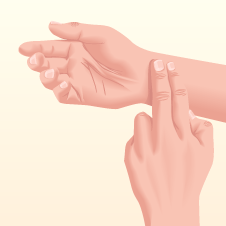
You can feel your pulse at certain points on your body. The easiest place to feel it is in your wrist, using the first two fingers of your other hand.
When you sit, the average heart beats about80 times per minute. However, everybody is different, so your pulse could be higher or lower than this.
When you exercise, your heart beats more quickly. This is because your muscles are working harder and need more oxygen to keep going. Your lungs also work harder, making you breathe more quickly to get more oxygen.
When you sleep, your muscles need less oxygen, so your heart slows down.
Your Pulse